What 10 NGO and UN calls for proposals reveal about turning complex knowledge into accessible communication
Translation is about meaning, not language
We have a hunch that many nonprofits are seeking external comms support to ‘translate’ technical information for the public. It’s been a more and more common theme in conversations and we wondered if that filtered through into calls for proposals published online.
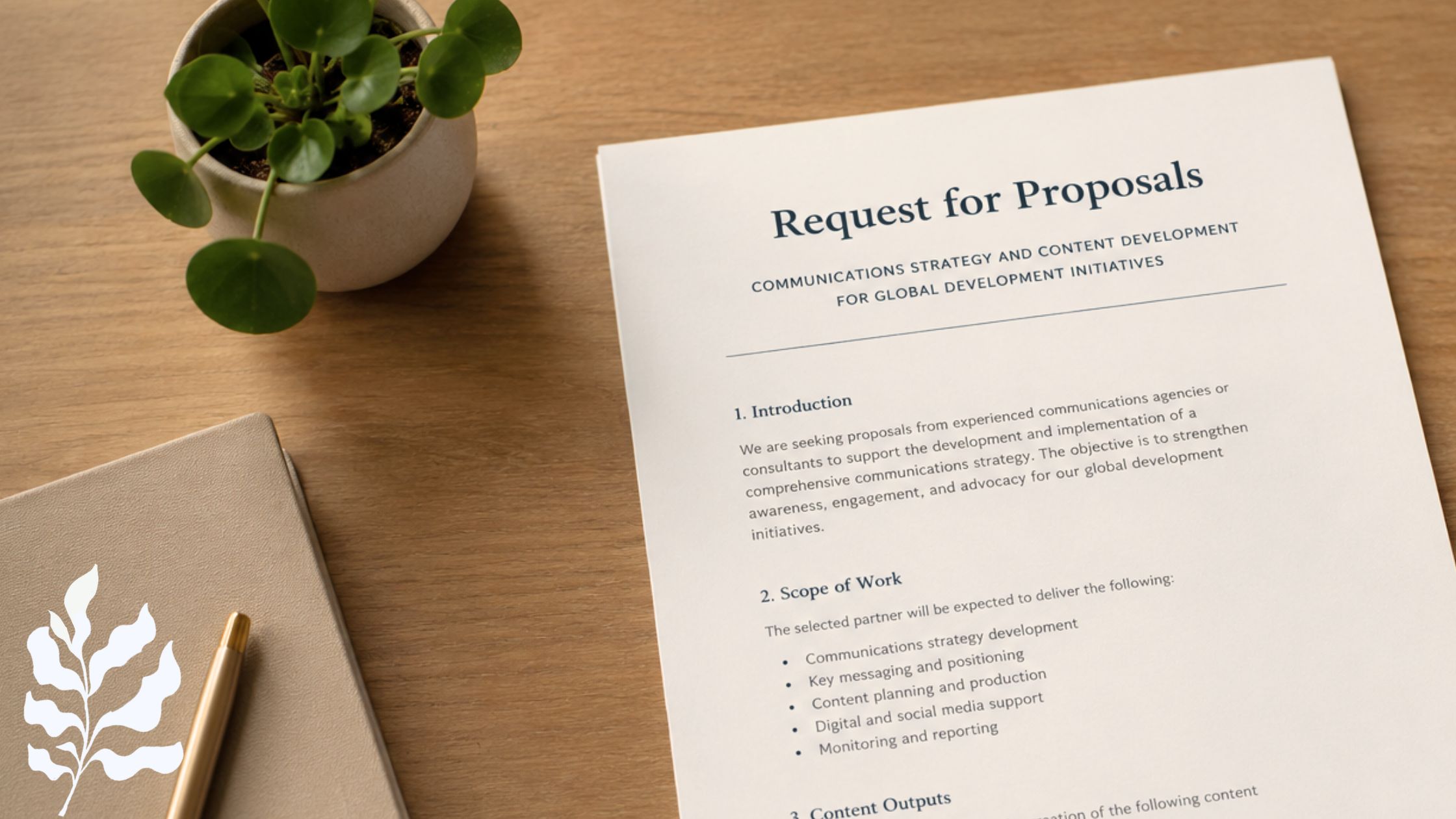
So we took a look. We reviewed 10 recent calls for proposals from NGOs, foundations and UN agencies published between 2024 and early 2026, sourced from UNGM, ReliefWeb, WHO and organisational procurement pages. To be included in our review, translation and adaptation had to be treated as baseline requirements in the communications work being commissioned.
Across the calls, we saw the same need repeatedly. Organisations are asking for support to interpret technical content and make it usable for different audiences.
A quick snapshot from the review:
- Multi-format outputs required: 8/10
- Accessibility elements such as captions or plain language: 6/10
- Contextual or cultural adaptation: 5/10
- Explicit collaboration with technical teams: 7/10
This says something about the comms environment that many of us operate in. We deal with complex information that can seem try or inaccessible to non-experts. That makes us prone to jargon – and ultimately, even brilliant organisations struggle to explain what they do.
From what we’re seeing, the gap is not only in writing skills. It is process, ownership and decision-making around how technical knowledge becomes communication.
Start with the audience, not the content
One of the clearest patterns is the expectation that the same material will be adapted for multiple audiences.
Several calls explicitly referenced:
- “accessible summaries for civil society audiences” (UNAIDS)
- “public-facing health guidance” (WHO)
- “communications products for media and stakeholders” (GAIN)
This points to a consistent requirement: translation begins with audience definition, not rewriting.
In practice, this means:
- Clarifying what the audience already knows
- Identifying what they need to understand
- Deciding what action should follow
The same principle applies to all external communications – we’ve seen many organisations skip this step, or drift away from their audience insight work, with the results meaning lower engagement and less impact through communications. Even accurate content is unusable if it’s not tooled specifically for the audience and channel it needs to serve.
Distil and rebuild the message
Technical content is dense because it is designed for precision. Translating it requires a different process: distillation and reconstruction. It can help to have a sector specialised comms partner that understands your subject matter, especially if it is very complex. But this process is also about good professional habits such as asking good questions, listening carefully, and empathising with what the audience is prepared to engage with.
Across the 10 RFPs, and in our general work, we’ve seen organisations asking for:
- Summaries of reports
- Key messages from research
- Stories derived from programme data
The work is not to simplify sentence by sentence. It is to:
- Define the core idea
- Explain why it matters (sometimes harder than it sounds)
- Rebuild it in a form that works for the audience
For example, a finding like ‘improved outcomes from x health programme’ becomes meaningful only when it answers what will concretely change right now, for a clinician, a caseworker or a community organiser.
In practice, translation means: define the audience, choose the one action, preserve the key terms, then rebuild the story around what changes.
Designing for how content gets published
Another consistent requirement is the range of outputs expected from a single piece of technical work.
Typical deliverables included:
- Briefs and summaries
- Social and media content
- Webinars with captions and transcripts
- Multilingual adaptations
This reflects how teams publish now: one core message, many outputs.
This also explains why contextual adaptation appears in half the calls we reviewed. Content needs to work across languages, cultures and settings. Direct translation is rarely sufficient. Tone, examples and framing all need adjustment to remain accurate and relevant. And in an AI-forward comms environment, it is still essential to keep human judgement central to this process.
Accessibility is also becoming standard. Several calls explicitly required plain language or inclusive formats. This is not an add-on: meeting this benchmark is core to whether content meets publication standards at all.
Build confidence through collaboration
Seven of the ten calls referenced collaboration with technical teams, either explicitly or through requirements for iterative review.
This points to a structural issue. Some really brilliant organisations have strong technical expertise in their team, but limited internal confidence in (or capacity for) translating that expertise into public-facing communication.
External partners like us are often brought in to interpret technical material, shape the story, and support alignment between teams by making sure everyone understands what’s being said. Translation is not a handoff at the end: it is part of how teams decide what to say.
Translation = usability
Whatever great data your organisation may hold, it’s no good unless it’s usable. By growing internal skills in translating technical content, or by hiring a partner like AMS to help, comms materials take a huge leap upwards in their clarity and usability. That in turn delivers better value for the time, effort and resources investment, proving that comms delivers.
–
AMS brings clarity to complex communications: we deliver senior comms strategy and creative content for organisations in international multi-stakeholder environments. To find out more, visit our homepage or get in touch.